


The AI Revolution's Hidden Real Estate Play: Why Data Centers Are Reshaping Commercial Property Investment
- Feb 5
- 10 min read
The artificial intelligence boom isn't just transforming software and services—it's fundamentally reshaping commercial real estate in ways most investors haven't fully grasped yet. While the world focuses on ChatGPT, Claude and generative AI applications, a quieter revolution is happening in warehouses, industrial parks, and purpose-built facilities across the globe: the explosive growth of AI-optimized data centers as a distinct and increasingly critical asset class.
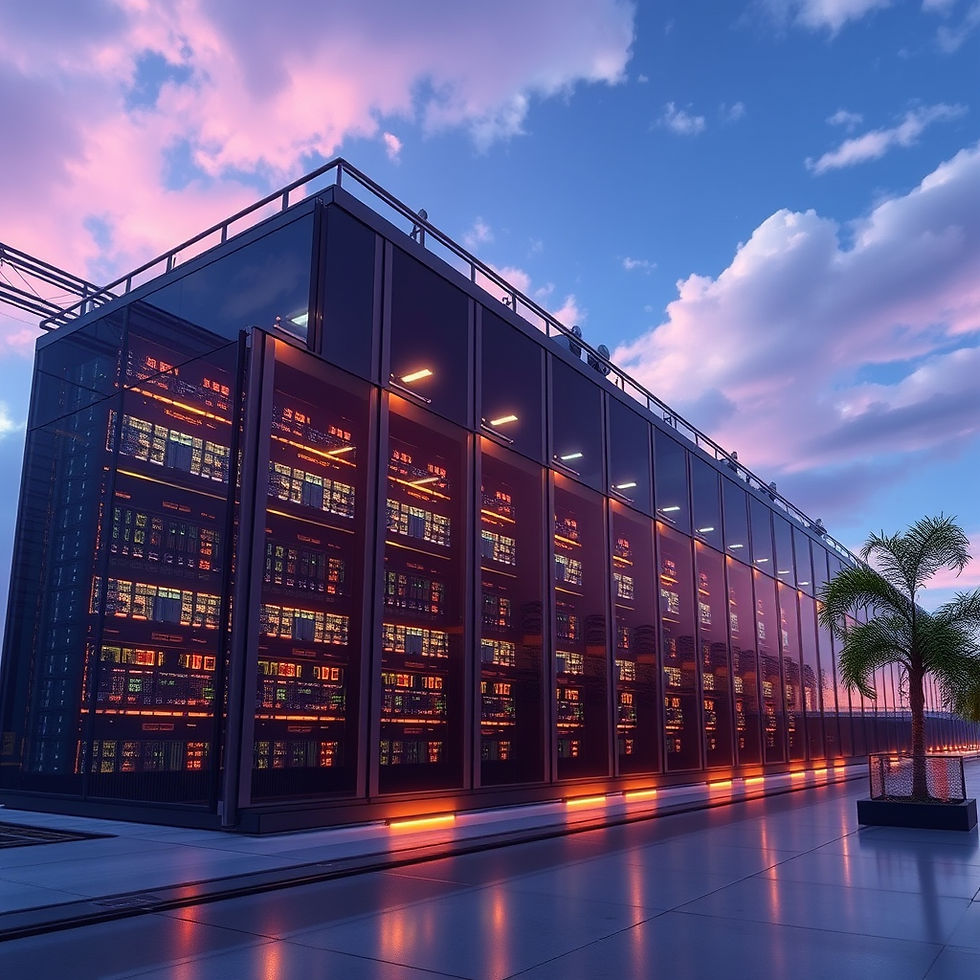
Having worked across both technology and commercial real estate sectors for nearly two decades, I've watched these two worlds converge in fascinating ways. But nothing has accelerated this convergence quite like the AI explosion of the past two years. What we're witnessing isn't just incremental growth in data center demand—it's a fundamental restructuring of how we think about real estate, infrastructure, and the physical requirements of the digital economy.
The Scale of AI's Infrastructure Demands
To understand why data centers are becoming a premier real estate asset class, you first need to grasp the sheer scale of AI's infrastructure requirements.
Traditional data centers—the ones powering your email, streaming services, and cloud storage—already consume massive amounts of power. A typical hyperscale data center might use 20-50 megawatts of electricity. For context, that's enough to power 15,000 to 40,000 homes.
AI data centers operate on an entirely different scale. Training a single large language model like GPT-4 or Claude can require facilities consuming 100+ megawatts. Inference—the process of actually running these models to serve users—adds continuous, sustained demand. OpenAI's infrastructure reportedly consumes enough power to run a small city, and they're far from alone.
Why AI Changes Everything
The difference isn't just scale—it's the nature of the computational workload:
Compute Density: AI workloads, particularly training large models, require GPU clusters that generate 3-5x more heat per rack than traditional servers. This fundamentally changes facility design, cooling requirements, and power delivery systems.
Always-On Operations: Unlike traditional enterprise computing with peak and off-peak periods, AI training runs continuously, 24/7/365. There's no "quiet time" for maintenance or reduced power draw.
Interconnectivity Requirements: AI training clusters require extremely low-latency, high-bandwidth connections between thousands of GPUs. This drives demand for facilities with advanced networking infrastructure and proximity to other computing resources.
Rapid Scaling: AI companies are scaling infrastructure faster than any technology sector in history. What used to take 3-5 years to plan and deploy now needs to happen in 12-18 months.
This creates unprecedented demand for a very specific type of real estate asset.
Data Centers as a Commercial Real Estate Asset Class
For decades, data centers were viewed as specialty industrial properties—interesting, but niche. That's changing rapidly.
Institutional Investment Surge
Major institutional investors—pension funds, sovereign wealth funds, private equity—are now treating data centers as a core asset class alongside offices, retail, and multifamily residential. Blackstone, Brookfield, and other giants have deployed billions into data center acquisitions and development.
Why? The fundamentals are compelling:
Long-term Leases: Data center tenants typically sign 10-15 year leases, often with built-in rent escalations. This provides income stability that most commercial real estate can't match.
Credit-Worthy Tenants: The tenant base includes Microsoft, Amazon, Google, Meta, and other investment-grade corporations. Default risk is minimal.
Triple-Net Structures: Many data center leases are triple-net, meaning tenants cover operating expenses, property taxes, and insurance. Landlords receive predictable net income.
Supply Constraints: Building new data centers, particularly AI-optimized facilities, faces significant barriers: power availability, fiber connectivity, water access (for cooling), and increasingly, regulatory approval. These constraints limit supply and support pricing power.
Inflation Hedging: Power costs are typically passed through to tenants, and lease escalations often tie to CPI or have fixed annual increases. This provides natural inflation protection.
The Numbers Tell the Story
Global data center capacity is projected to grow 15-20% annually through 2030. AI workloads are expected to drive 40-50% of new demand. Investment in data center real estate reached over $50 billion globally in 2023, and 2024 is tracking higher.
In markets like Northern Virginia—the world's largest data center hub—vacancy rates are near zero, and land prices for sites with available power have tripled in three years. Similar dynamics are playing out in Dublin, Frankfurt, Singapore, and other key markets.
This isn't a bubble. It's structural transformation driven by fundamental shifts in how computing infrastructure scales.
The Energy Constraint: Real Estate's New Limiting Factor
Here's where it gets really interesting for commercial real estate: energy has become the primary constraint on data center development, fundamentally changing how we evaluate and develop property.
Power as the Scarce Resource
Traditionally, commercial real estate development was constrained by:
Land availability and zoning
Capital and financing
Construction capacity
Demand/absorption
For data centers, particularly AI-optimized facilities, the binding constraint is increasingly available electrical power.
A 100-megawatt AI data center requires as much power as a small aluminum smelter or industrial manufacturing complex. Securing this level of power availability is often the longest and most uncertain part of the development process.
Geographic Implications
This energy constraint is reshaping data center geography in profound ways:
Power-Rich Regions Win: Areas with abundant, reliable, affordable power—often from hydroelectric or renewable sources—are becoming prime markets. The Pacific Northwest, Nordic countries, and parts of Canada are seeing surging demand.
Grid Capacity Matters: It's not just about power generation; it's about grid infrastructure to deliver that power. Many traditional tech hubs (Silicon Valley, London, Singapore) face grid constraints that limit data center growth.
Regulatory Complexity: In Europe, securing grid connections for new large-scale data centers now requires navigating complex regulatory frameworks, environmental assessments, and increasingly, guarantees around renewable energy usage.
Emerging Markets: Countries with energy surplus—particularly those with stranded renewable capacity—are actively courting data center development. Iceland, with its geothermal abundance, has become a hub. Middle Eastern nations with solar capacity are positioning themselves similarly.
The Energy-Real Estate Investment Thesis
Forward-thinking real estate investors are now evaluating properties not just on traditional metrics (location, building quality, tenant demand) but on energy infrastructure:
Proximity to power substations with available capacity
Access to renewable energy sources
Grid upgrade potential and utility cooperation
Regulatory environment for power-intensive uses
Long-term energy cost trajectories
I've seen industrial properties that would traditionally be valued at $50-100 per square foot commanding multiples of that when they sit adjacent to substations with 50+ megawatts of available capacity. The real estate value is increasingly a function of the energy infrastructure, not the building itself.
Geopolitical Dimensions: Data Sovereignty and Strategic Assets
The intersection of AI, data centers, and real estate extends into geopolitics in ways that would have seemed far-fetched a decade ago. But today, data center infrastructure is increasingly viewed as strategic national assets.
Data Sovereignty and Regulatory Fragmentation
Governments worldwide are implementing data localization requirements—mandating that certain data must be stored within national borders. This isn't just about privacy; it's about economic and national security.
European Union: GDPR and subsequent regulations require much personal data to remain in EU data centers. This has driven massive investment in European facilities.
China: Strict data localization laws require foreign companies operating in China to use Chinese data centers, creating a parallel infrastructure ecosystem.
India: Data Protection Act proposals would require "critical" personal data to be stored exclusively in India.
Russia: Has implemented some of the strictest data localization requirements, forcing companies to maintain Russian-based infrastructure.
For commercial real estate, this creates geographically segmented markets with localized demand drivers. A data center in Frankfurt can't substitute for one in Singapore, regardless of price or capacity.
Strategic Competition and National Security
Data centers are increasingly viewed through a national security lens:
AI Competitiveness: Nations recognize that AI capability depends on computing infrastructure. China's restrictions on high-end chip imports have driven domestic data center investment. The U.S. views advanced data center infrastructure as critical to maintaining technological leadership.
Undersea Cables and Connectivity: The submarine cables connecting continents and the landing stations where they come ashore have become geopolitically sensitive. Real estate at these nodes commands strategic premiums.
Dual-Use Infrastructure: Governments are recognizing that the same infrastructure powering commercial AI also has military and intelligence applications. This is driving public-private partnerships and, in some cases, government investment in ostensibly commercial facilities.
Export Controls: The U.S. has implemented restrictions on exporting advanced AI chips to certain countries. This is driving a bifurcation of global data center infrastructure—facilities using leading-edge technology versus those limited to older generations.
Investment Implications
For real estate investors, these geopolitical dimensions create both opportunities and risks:
Opportunities:
Markets with clear, stable regulatory frameworks command premiums
Countries positioning themselves as neutral, trusted locations (Switzerland, Singapore) attract capital
Renewable-heavy grids aligned with ESG requirements have competitive advantages
Risks:
Regulatory changes can strand assets or require expensive modifications
Geopolitical tensions can disrupt cross-border investment and operations
Technology export restrictions can limit facility competitiveness
I've watched European commercial real estate investors increasingly favor data center assets precisely because of these dynamics—the combination of growing demand, regulatory moats, and government support creates unusual downside protection.
What This Means for Real Estate Investors
If you're evaluating commercial real estate opportunities, here's how to think about the data center opportunity:
Due Diligence Has Changed
Traditional real estate due diligence—building condition, location, tenant quality—remains important. But for data centers, you need to add:
Energy Infrastructure Assessment:
Current power availability and reliability
Grid upgrade potential and timeline
Utility cooperation and track record
Renewable energy access and cost
Backup power capabilities (generators, battery storage)
Cooling and Water:
Cooling system efficiency and redundancy
Water availability (for evaporative cooling systems)
Climate considerations (ambient temperature affects efficiency)
Connectivity:
Fiber optic infrastructure and carriers present
Distance to internet exchange points
Latency to major population centers
Redundant network paths
Regulatory and Political:
Zoning and land use certainty
Data localization requirements
Environmental and permit risks
Government incentives or barriers
Community and political support
The Development vs. Acquisition Decision
Building new data centers offers higher returns but faces significant risks:
Challenges:
2-3 year development timelines
Securing power allocation (often the longest part)
Technology changes during development
Tenant pre-leasing typically required for financing
High upfront capital requirements ($1,000+ per square foot for purpose-built AI facilities)
Opportunities:
Build-to-suit for credit tenants locks in returns
Scarcity in power-constrained markets supports premium pricing
Modern facilities command higher rents and better terms
Control over design optimizes for current technology
Acquiring existing facilities offers faster deployment but often at premium valuations:
Considerations:
Quality facilities in prime markets trade at low cap rates (4-6%)
Legacy facilities may require significant upgrades for AI workloads
Tenant rollover risk if leases are maturing
Competition from REITs and institutional capital
The Co-location vs. Hyperscale vs. Edge Distinction
Not all data centers are equal. Understanding the sub-segments is critical:
Co-location Facilities:
Multi-tenant shared infrastructure
Smaller deployments (typically sub-megawatt)
Urban locations serving enterprise customers
More stable, diversified tenant base
Lower risk, lower returns
Hyperscale Facilities:
Large (20-100+ MW), typically single-tenant
Leased long-term to tech giants or cloud providers
Suburban/ex-urban locations with power access
Higher returns, concentration risk
AI training facilities typically fall here
Edge Data Centers:
Smaller facilities (1-10 MW) close to end users
Low-latency requirements drive location
Growing segment for AI inference and 5G
Urban locations, higher land costs
Emerging opportunity
The AI boom is primarily driving hyperscale investment, but edge facilities are growing as AI inference (running models for users) scales.
Future Outlook: Where This Goes Next
Looking ahead, several trends will shape data center real estate:
Nuclear Renaissance?
The energy demands of AI are so large that some companies are seriously exploring dedicated nuclear power. Microsoft has investigated small modular reactors (SMRs) to power data centers. If SMRs achieve commercial viability, they could enable data centers in locations currently power-constrained.
This would fundamentally change the geography of the sector—imagine viable facilities in dense urban areas or energy-scarce countries, powered by on-site nuclear generation.
Offshore and Floating Data Centers
Google and others have explored floating data centers—using seawater for cooling and potentially offshore wind for power. If regulatory and technical challenges are solved, this could open new frontiers.
Vertical Integration
Tech giants are increasingly bypassing traditional landlord-tenant models, developing their own facilities. This shifts investment opportunities toward land, power infrastructure, and specialized construction rather than ownership of operating facilities.
Liquid Cooling Adoption
As compute density increases, traditional air cooling reaches physical limits. Liquid cooling—immersing servers in non-conductive fluid—is gaining adoption. This requires different facility designs and creates retrofitting challenges for older buildings.
AI Efficiency Improvements
Conversely, improvements in AI efficiency could moderate demand growth. New chip architectures, algorithmic advances, and better software optimization might reduce power requirements per unit of computation. This is the key uncertainty in long-term forecasting.
Lessons from the Intersection
What fascinates me about this space is how it demonstrates the convergence of seemingly unrelated domains:
Technology dictates real estate: Server architecture and AI algorithms influence building design, HVAC systems, and power infrastructure in ways unimaginable a decade ago.
Energy becomes destiny: Power availability and cost—often afterthoughts in traditional real estate—now drive valuations and investment decisions.
Geopolitics shapes markets: National security concerns and data sovereignty create market fragmentation and localized dynamics that don't exist in most real estate sectors.
Speed matters differently: Technology timelines (12-month upgrade cycles) clash with real estate timelines (5-10 year development and lease terms), creating tension and opportunity.
For investors who can navigate this complexity—understanding both the technology fundamentals and the real estate dynamics—the opportunities are significant. But this isn't a space for pure-play real estate investors or pure-play tech investors. It requires fluency in both domains.
Final Thoughts
The AI revolution is often discussed in terms of software, applications, and societal impact. But underpinning all of it is physical infrastructure—buildings, power systems, cooling facilities, fiber networks. These are fundamentally real estate assets.
As AI continues its exponential growth, the demand for specialized data center real estate will only intensify. Energy constraints, geopolitical fragmentation, and technology evolution will create winners and losers among markets, assets, and investors.
For those of us working at the intersection of technology and real estate, this is the most dynamic period in decades. The principles of real estate investment—location, scarcity, long-term income streams—remain relevant. But the definition of "good location" has changed from foot traffic or highway access to fiber density and power availability. Scarcity is now about grid capacity, not just land. And income streams depend on understanding AI workloads and technological trajectories, not just tenant financials.
The data center sector offers a fascinating case study in how technological disruption reshapes even the most tangible, physical industries. Real estate, for all its reputation as a stable, slow-moving sector, is being transformed by lines of code and neural networks.
Those who understand this transformation early—who can evaluate power substations as fluently as building conditions, who track AI chip roadmaps alongside lease terms—will be well-positioned for the decade ahead.
The AI revolution isn't just digital. It's physical, spatial, and very much about real estate. And it's just getting started.
About the Author
George Kakouras has 20+ years of experience at the intersection of Technology and Real Estate. He brings a unique perspective combining deep technical expertise with real-world real estate investment and operations.


Comments